
Introduction
Accuracy, speed, and compliance in the laboratory environment are imperative to sustainable development in the modern laboratory. A Laboratory Information Management System is important in automating the processes in laboratories and enhancing the management of data. The laboratory information management system is reliable in reporting and secure operations in relation to diagnostics to billing. Combined with the Laboratory Billing Software and Pathology Lab Software, laboratories will be able to go through with smooth automation.
The role of the LIMS in healthcare today is to allow structured processing, correct report generation, and compliance-based approvals. Knowledge of advantages of the solution of laboratory information management systems aids the labs to enhance efficiency and cross-departmental decision-making.
The Process of Processing Accurate Report Creation Through the Use of LIMS Software
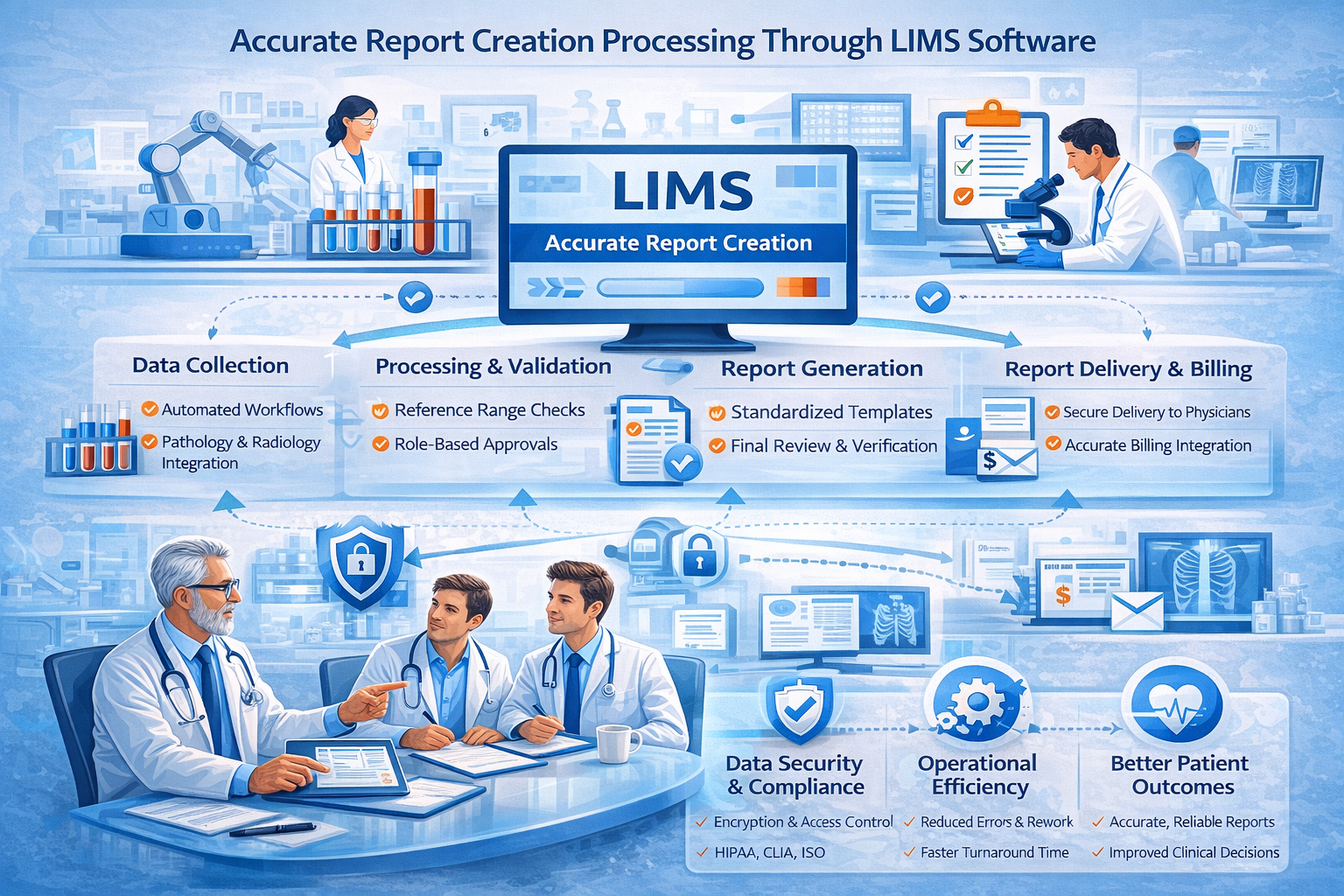
The quality of laboratory services is based on the correct processing of report creation using the systems of Laboratory Information Management. The process of report creation does not just focus on the generation of test results, but it is a structured process of data processing, validation, approval and delivery in a secure manner. To facilitate consistency, traceability and compliance, a LIMS laboratory information management system combines diagnostic workflows and Pathology Lab Software, Laboratory Billing Software, and a lab management information system.
Laboratories that are used today deal with a large number of samples in a day. Devoid of a systematic working process, errors like mislabeling, late reporting, and wrong billing may arise. Using a Laboratory Information Management System, the labs are able to standardize all the processes involved; starting with the reception of the samples through to delivery of the final reports. The use of LIMS in the healthcare sector changes raw laboratory data into meaningful clinical data, which assists physicians to make informed decisions. Reporting is accurate and timely, patient outcomes are improved, revenue cycles run more efficiently and the credibility of the laboratory is increased.
A Laboratory Information Management System Report Creation
Creation of Reports
Creation of reports is an important role of a Laboratory Information Management System. The laboratory information management system automates the collection, validation and formatting of the test results and at the same time upholds the accuracy. The platform of the LIMS laboratory information management systems with high processing logic minimize the errors of the manual calculation, transcription errors, and delays of the reporting enough to be prevalent in the paper-based system.
A lab management information system integrated with a modern Pathology Lab Software enables the laboratories to design the formatting of reports, reference ranges and interpretation notes. These tools enhance consistency in the various departments, enable standardization in the output of the diagnostic results, and provide meaningful reports which are clinically correct and easily accessible to physicians.
Role of LIMS in Healthcare
LIMS are applicable in healthcare by facilitating:
- Departmental Automated processing of data, making sure that out of the hematology, biochemistry, microbiology, and histopathology, results are appropriately and effectively captured.
- Standard report templates, which would lead to clarity and consistency in clinical interpretation.
- Integration with Laboratory Billing Software to align clinical data with financial operations in order to reduce billing errors and provide correct reimbursement.
Through a Laboratory Information Management System, laboratories may ensure that all reports are operational, medical and regulatory at the required standards. Moreover, laboratories are also capable of monitoring report delivery time, assessing turnaround efficiency and detecting delays or errors in a short time, which proves the benefits of information management systems implementation in laboratories and the advantages of their use.
Approval Procedure of Correct Processing and Compliance
Well-Organized Approval Method
A well-organized method of approval is needed to have trustful processing of reports. The use of a Laboratory Information Management System supports a multi-level approval workflow, so that all test results should be analyzed and confirmed before releasing the report. This system will grant pathologists, laboratory technicians, and administrators role based permissions, which makes the accountability at each level clear.
In a lab management information system, it is possible to define approval hierarchies, generate audit trails, and track report validation in real time with Pathology Lab Software. This systematic review depicts the role of LIMS in healthcare through the reduction of risks in diagnosis and preservation of patient information integrity.
Advantages of LIMS Approval Approaches
The most important advantages of the approaches in laboratory information management system approval are:
- Restricted report validation by pre-determined role-based access where only qualified staff are allowed to access sensitive data.
- Less rework and mistakes as automation of the verification process is done.
- Effortless connectivity with Laboratory Billing Software, which connects approvals to financial records to stop billing failure or billing errors.
Through standardized approval processes, the laboratories ensure their adherence to the regulatory requirements, enhance efficiency in operations, and ensure correctness of findings in diagnostic reporting.
Radiology Information System LIMS Interchange
Enhanced Accuracy and Reporting Speed
A combination of a Radiology Information System with a Laboratory Information Management System enhances the accuracy of the diagnosis and the speed of the reporting. Radiology information usually needs to undergo systematic treatment before it is added to laboratory reports especially when they are used with the pathology results in an effort to provide a comprehensive assessment of a patient.
The information management system used by the lab handles the imaging findings as well as pathology information where all diagnostic information is connected through an accession number. Radiology results are also standardized and safely integrated in the patient records through the integration of pathology lab software and lab management information system.
Role of LIMS in Healthcare
LIMS are used in healthcare to tie up diagnostic silos and to enable clinicians to view data on patients in a holistic way. Integration is the measure that guarantees interdisciplinary teams (radiologists, pathologists, and clinicians) can work effectively, minimizing errors and enhancing patient outcomes. The advantages of the integration of laboratory information management systems are better coordination, less duplication, more accurate reporting, and easier billing with the help of Laboratory Billing Software.
The Information on the Security of Laboratory Data in Information Management System Processing
Data Security in LIMS
A report creation process cannot be done without data security. A Laboratory Information Management System provides protection to patient and diagnostic sensitive patient and diagnostic information over the processing lifecycle. Laboratory information management system implements encryption, role-based access control and audit logging in order to maintain confidentiality and compliance.
With the help of the LIMS laboratory information management system architecture, labs can adhere to the requirements of the healthcare data including those of the HIPAA, CLIA, and ISO standards. Pathology Lab Software and Laboratory Billing Software share data safely in the laboratory management information system that eliminates unauthorized access, tampering, or breach.
Role of LIMS in Healthcare Security
LIMS have their roles in healthcare such as safeguarding the integrity of data and making all reports confidential and unalterable. The advantages of security features of laboratory information management systems are that they enhance patient trust, regulatory compliance and operational reliability in high-volume diagnostic settings.
Processing: The Fundamentals of Accurate Report Preparation
The key to the proper creation of reports within a Laboratory Information Management System is processing. It includes gathering crude test information, verifying such data, using reference ranges, and converting the information into organized reports. Laboratory information management system automates such workflow in order to remove inconsistencies and speed up reporting.
Processing rules in a LIMS information management laboratory system can assure proper interpretation and contextualization of the results of the Pathology Lab Software and Radiology Information Systems. LIMS have a role to play in the health care system by enabling accurate diagnosis, facilitating clinical decisions, and providing better patient care.
Real-time updates, multiple approvals, and integration of the Laboratory Billing Software is also facilitated in an efficient processing of a lab management information system to lower the turnaround time and improve the overall reliability. Laboratories can devote their energies to the high-value processes, including diagnostic review, intricate analysis, and quality control, by automating repetitive business operations, which shows the complete advantages of adopting laboratory information management systems.
Laboratory Billing Software and its Role in Accuracy of Reports
Precise reports have a direct effect on the billing results. A Laboratory Information Management System is developed and installed hand in hand with Laboratory Billing Software in order to make sure that all tests that are done are billed properly. The laboratory information management system connects report information with the respective billing codes so that the revenue is not leaked and reimbursement is made correctly.
Pathology Lab Software, which can be used in a lab management information system, helps a laboratory to decrease the differences in finances, accelerate the reimbursement process, and enhance the clarity of finances. The role of LIMS in healthcare is the alignment of clinical operations with financial operations, the enhancement of operational efficiency, and sustainability.
Advantages of the integration of the laboratory information management system billing are the improved transparency, faster revenue collection, improved compliance, and greater confidence among the concerned parties, including not only clinicians and administrators but also all stakeholders.
Advantages of Laboratory Information Management System to Laboratories
The benefits of the adoption of a Laboratory Information Management System are more than automation. The laboratory information management system increases the efficiency of operations, improves accuracy in data, regulative compliance, and centralization of laboratory operations.
Laboratories have the end-to-end workflow optimization when integrated with the LIMS laboratory information management systems, Pathology Lab Software, and Laboratory Billing Software. The staff will be able to view real time sample status, track quality metrics, and deliver reports on time.
These features are a clear indication of the role that LIMS can play in the healthcare sector, enhancing quality-based diagnostics, better patient outcomes, as well as financial and operational integrity. Scalability, sustainability and long-run efficiency in the contemporary laboratory settings is guaranteed with the adoption of a lab management information system.
Conclusion
The current laboratories require proper report generation processing using the solution of Laboratory Information Management System. The laboratory information management system is reliable in that it integrates processing, approvals, radiology data, and security to guarantee the provision of reliable results. Laboratories with Pathology Lab Software, Laboratory Billing Software, and effective lab management information system are excellent in terms of operations. Finally, LIMS are useful in healthcare in improving accuracy, compliance, and patient trust and provide quantifiable business value.
Author’s Bio:
Hi, I’m Parth Makvana, and I work in SEO at Healthray Technologies Pvt. Ltd. I help improve our online visibility while supporting awareness of Healthray products — including Hospital Information Management System (HIMS), and enhance patient care.