
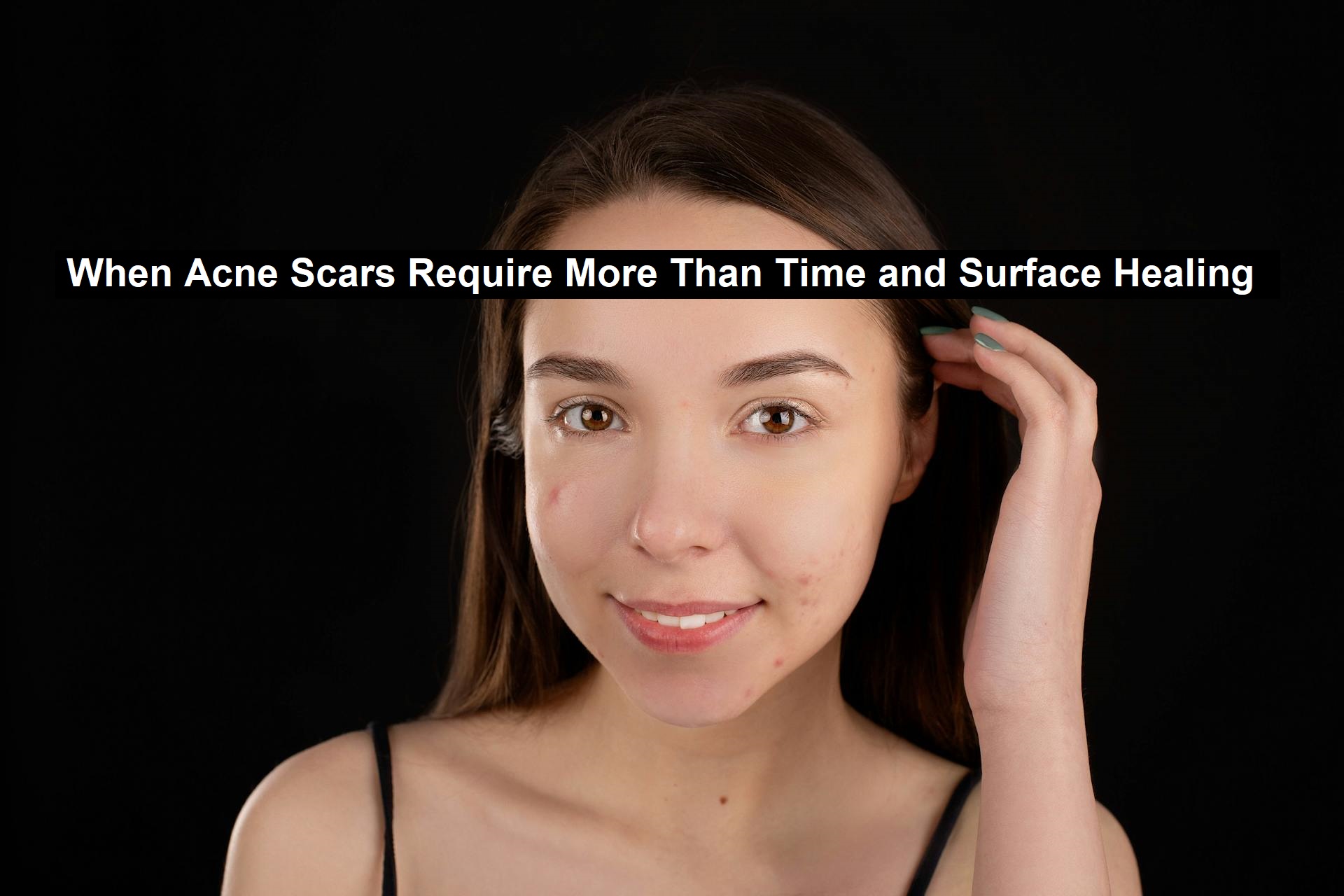
Acne scars are often described as a delayed consequence of inflammation, appearing after active breakouts have settled. While some mild marks gradually fade as the skin renews itself, others persist for years despite careful skincare. This difference reflects how deeply inflammation affected the skin and how the healing process unfolded at the time of injury. Medically, acne scarring represents a structural alteration of the dermis rather than a surface-level problem.
As people age, the skin’s ability to compensate for earlier damage declines. Collagen production decreases by approximately 1% per year after early adulthood, dermal thickness gradually reduces, and microcirculation becomes less efficient. These changes mean that scars formed in adolescence or early adulthood may become more visible over time. For individuals considering acne scar removal treatment in Singapore, understanding when scars require more than passive healing is essential for setting realistic expectations and choosing appropriate interventions.
Why Acne Scars Become a Medical Concern Over Time
During inflammatory acne, immune mediators such as cytokines and proteolytic enzymes are released into the surrounding tissue. When inflammation extends into the dermis, it disrupts collagen fibers and the extracellular matrix that provides structural support. If collagen breakdown exceeds collagen synthesis during healing, the skin repairs itself with a net loss of volume, resulting in atrophic scars.
In younger skin, higher fibroblast activity and thicker dermal layers may partially mask these defects. With aging, reduced collagen density and gradual fat loss in the face can accentuate existing depressions. Scars that were once barely noticeable may become more apparent under normal lighting or facial movement. At this stage, time alone is unlikely to produce further improvement, and surface-level treatments often have limited effect.
Screening and Early Identification of Scar Patterns
Clinical assessment plays an important role in determining whether acne scars are likely to improve spontaneously or require intervention. Dermatologists typically classify scars into ice pick, boxcar, and rolling types based on depth, width, and underlying fibrous attachments. Ice pick scars extend deep into the dermis, boxcar scars have sharp edges and defined borders, and rolling scars are caused by fibrous bands tethering the skin downward.
Early identification of scar type allows treatment to be tailored appropriately. For example, superficial textural irregularities may respond to topical therapy and mild resurfacing, whereas deeper scars often require procedures that reach the mid to deep dermis. A dermatologist in Singapore may also assess skin thickness, elasticity, and pigmentation risk, particularly in individuals with darker skin tones who may be more prone to post-inflammatory hyperpigmentation after treatment.
Daily Care and Lifestyle Factors That Influence Scar Visibility
Although scars themselves are structural, daily habits influence how visible they appear. Chronic ultraviolet exposure accelerates collagen degradation and reduces skin elasticity, making scar depressions more pronounced. Consistent use of broad-spectrum sunscreen with an SPF of 30 or higher helps preserve surrounding dermal support and prevent secondary pigment changes.
Skin barrier integrity is another key factor. Overuse of exfoliating acids, scrubs, or aggressive devices can increase inflammation and compromise healing, potentially worsening uneven texture. Gentle cleansing and appropriate moisturization help maintain a stable environment that supports gradual remodeling.
Lifestyle factors such as sleep and nutrition also play indirect roles. Adequate sleep supports growth hormone secretion, which contributes to tissue repair. Protein intake provides amino acids necessary for collagen synthesis, while vitamin C is required for collagen cross-linking. Smoking, in contrast, reduces blood flow and oxygen delivery to the skin, often impairing wound healing and collagen formation.
Age-Related and Chronic Conditions That Affect Healing
As skin ages, its regenerative capacity declines. Older skin has fewer active fibroblasts and a thinner dermal matrix, limiting how much collagen remodeling can occur naturally. Hormonal changes may also affect skin hydration and elasticity, influencing scar appearance.
Chronic inflammatory skin conditions such as eczema or rosacea can complicate scar management by weakening the skin barrier and increasing sensitivity. In some individuals, a predisposition to abnormal scarring, including hypertrophic scars or keloids, may influence treatment selection and recovery expectations.
Ongoing acne activity is another important consideration. New inflammatory lesions can continue to damage the dermis, undermining attempts to improve existing scars. Effective control of active acne is therefore often a prerequisite for successful scar treatment.
Prescription Treatments Versus Over-the-Counter Options
Topical treatments can support scar management but have inherent limitations. Over-the-counter products commonly contain retinol at concentrations below 1%, which may modestly improve surface texture and discoloration by increasing epidermal turnover. These products generally require consistent use over several months and are most effective for shallow irregularities.
Prescription retinoids, such as tretinoin at concentrations ranging from 0.025% to 0.1%, have stronger evidence for stimulating collagen synthesis and improving fine textural changes. Clinical improvement may become noticeable after 8 to 12 weeks of regular use. However, even prescription-strength topicals cannot fully correct deeper dermal defects.
Other prescription agents, including azelaic acid or pigment-correcting medications, may be used to address post-inflammatory hyperpigmentation associated with scars rather than scar depth itself.
Read: How to Feel 25 in Your 30s: 4 Changes That Actually Work
In-Clinic Procedures for Established Acne Scars
When scars extend into the mid or deep dermis, procedural treatments are often required to stimulate meaningful remodeling. Fractional lasers create microscopic columns of controlled thermal injury, activating fibroblasts while leaving surrounding tissue intact to aid healing. Non-ablative lasers typically involve shorter downtime, while ablative lasers may provide greater textural improvement at the cost of longer recovery.
Microneedling and radiofrequency microneedling mechanically disrupt the dermis, sometimes combined with heat, to promote collagen production. These treatments are commonly used for rolling and boxcar scars and usually require multiple sessions spaced several weeks apart.
Subcision targets fibrous bands beneath rolling scars. By releasing these tethers, the skin surface may gradually rise as new collagen forms. Swelling and bruising are common after the procedure but typically resolve within one to two weeks.
What Our Dermatologist Says
In my clinical practice, I often explain that acne scars are a record of past inflammation rather than a sign of current skin health. Once the collagen framework has been altered, the body has limited ability to restore it on its own.
I also emphasize that scar improvement is cumulative. Each treatment session contributes incrementally, and collagen remodeling continues for months. Managing expectations and addressing active acne alongside scar therapy are essential for achieving stable, long-term improvement.
Putting This Into Practice
- Have scars assessed to determine their type and depth
- Maintain daily sun protection to preserve dermal support
- Use prescription topical treatments consistently when appropriate
- Control active acne before or during scar treatment
- Attend follow-up visits to monitor progress and adjust plans
When to Seek Professional Help
- Scars that persist years after acne has resolved
- Depressions or texture changes affecting confidence
- Ongoing acne causing new scarring
- Dark marks that do not fade over time
- Interest in procedural treatments requiring medical supervision
Commonly Asked Questions
Why don’t all acne scars fade with time?
Deeper scars reflect permanent loss of collagen, which the skin cannot fully replace without intervention.
Can surface treatments correct deep scars?
Surface treatments may improve texture slightly but usually cannot reach the depth required to correct deep scars.
How many sessions are typically needed?
Many patients require three to six sessions, depending on scar severity and treatment type.
Is treatment less effective with age?
Aging skin may respond more slowly, but improvement is still possible with appropriate techniques.
Does scar treatment stop new scars from forming?
No. Preventing new scars requires effective control of active acne.
Next Steps
Acne scars that persist despite time and careful skincare often reflect deeper structural changes within the skin. If scarring remains a concern, a consultation with a dermatologist can help determine whether evidence-based procedures or combined approaches are appropriate for your skin type, age, and long-term goals.